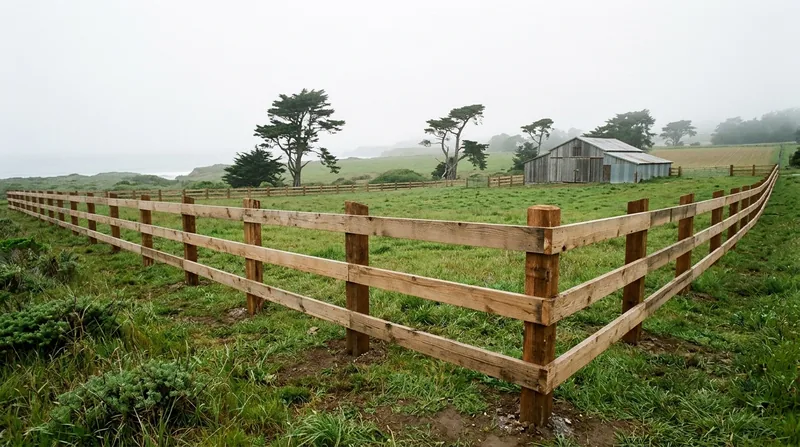




Farm fence installation in San Francisco and the surrounding Bay Area requires a different approach than typical residential fencing. The rolling hills of Marin, the coastal bluffs of San Mateo, and the inland valleys of Sonoma County present challenges that urban fences never face: soft bay fill that shifts under post foundations, salt air that corrodes hardware, Pacific wind that racks tall panels, and terrain steep enough to demand stepped or racked installation over dozens of linear feet. We handle ranch rail, no-climb horse fence, field wire and pipe fencing on acreage where straight lines matter and gates need to open for trailers and equipment. If you own property beyond the city limits and need a fence that holds its line and its function through years of weather and use, we work from your existing survey and install the fence you identify.
Why Farm and Ranch Fencing Matters on Bay Area Acreage
Acreage fencing is not a scaled-up version of a backyard fence. A ranch rail fence or no-climb horse fence must hold animals safely, frame property boundaries across uneven terrain, and survive years of weather, herd pressure, and seasonal ground movement. In Marin and coastal San Mateo, salt spray and fog drip accelerate rust on unprotected metal and rot on untreated wood. Soft ground on the bay side and loose soil in hill country let posts lean if they are not set deep enough in concrete or tamped and compacted to proper density. Wind that funnels through valleys can rack tall panels if bracing is not installed at corners and at intervals along long runs.
- We set posts deep in concrete footings to resist ground shift and frost heave over time.
- We brace corners and long straightaways to prevent racking under wind load and animal pressure.
- We size gates for equipment and trailers, with self-closing and self-latching hardware that holds without power.
- We choose materials rated for coastal salt air or specify galvanized fasteners and hardware to outlast the wood or pipe.
- We work stepped or racked over slopes so the fence follows the grade without gaps at the ground line.
A well-built ranch fence pays for itself in years of reliable service and the peace of mind that comes from knowing your animals are secure and your boundary is marked.
Local example: A five-acre horse property in Mill Valley with a steep north-facing slope and afternoon wind requires posts set 3.5 to 4 feet deep, corner bracing with anti-sag hardware, and a stepped installation to keep the fence line tight as the grade changes. The same property in Pacifica, closer to the coast, needs galvanized or stainless fasteners to resist salt air corrosion.
How We Install Farm and Ranch Fencing Across San Francisco Bay Area Hills
Every acreage job starts with a site walk and a clear understanding of your property line. We work from your existing survey and install the fence exactly where you identify it. Before we dig a single post hole, we call for a California 811 utility locate to mark underground lines. That step is required by law and protects both the job and your property. Once utilities are marked, we lay out the fence line, set posts at proper depth and spacing, install rails or wire, and frame gates sized for the equipment and animals you need to move.
- We verify the property line using your existing survey and mark the fence run with string or chalk.
- We call 811 for a free utility locate and wait for all lines to be marked before digging.
- We dig post holes to depth appropriate for soil type and climate, typically 3 to 4 feet for ranch fencing.
- We set posts in concrete footings, plumb them, and brace them if the run is long or the slope is steep.
- We install rails, wire, or pipe, checking for level and tension as we go.
- We frame and hang gates with hardware sized for the load and the frequency of use.
The result is a fence that holds its line and function through years of weather, animal pressure, and seasonal ground movement. For more detail on how we handle post repair and replacement when ground shift or rot occurs, see our fence post repair service.
Example job: A 12-acre ranch in Sonoma County with 800 linear feet of perimeter fencing required posts set 4 feet deep in concrete, corner bracing at four locations, three equipment gates with self-closing hinges, and 400 feet of no-climb horse fence on the south boundary. The work took three weeks and included stepped installation over two slope changes to keep the fence line tight and the ground clearance even.
Farm and Ranch Fencing Methods and Materials
The right material depends on what you are fencing, the terrain, the climate, and your budget. Ranch rail is classic, visible from a distance, and durable when built with pressure-treated posts and cedar or redwood rails. Split rail fence installation works well on rolling hills because it can be stepped to follow the grade. No-climb horse fence, typically a woven wire with horizontal stays spaced close enough that a hoof cannot pass through, is the safest choice for horses and small livestock. Pipe fence installation offers strength and longevity in coastal areas where salt air corrodes wood and fasteners. Barbed wire fence installation is economical for cattle and large acreage but requires careful post spacing and tension to stay tight. Field wire with posts and rails is a middle ground, affordable and functional for mixed grazing.
| Approach | Description | Best for |
|---|---|---|
| Ranch Rail | Pressure-treated posts with cedar or redwood rails, typically two or three rails high, set 6 to 8 feet apart. | Horses, small livestock, and aesthetic boundaries on rolling terrain. |
| No-Climb Horse Fence | Woven wire mesh with horizontal stays spaced 4 to 6 inches apart, stretched tight between posts and secured with tension bands. | Horses and small livestock where safety and containment are priorities. |
| Pipe Fence | Steel or galvanized pipe posts and rails, bolted or welded, rated for high wind and salt air corrosion. | Coastal properties, high-wind sites, and long-term durability in harsh climates. |
| Field Wire with Posts and Rails | Galvanized wire mesh stapled to posts and topped with one or two rails, typically set 8 to 10 feet apart. | Mixed grazing, cost-conscious acreage, and moderate terrain where visibility is not a priority. |
| Barbed Wire Fence | High-tensile or standard barbed wire stretched between posts, typically three to five strands, set 12 to 16 feet apart. | Cattle ranches, large acreage, and perimeter fencing where cost per linear foot is the primary concern. |
Farm and Ranch Fencing Cost in San Francisco Bay Area: What to Expect
Farm fence installation pricing depends on terrain, material, and site access. A basic ranch rail fence on level ground starts around $12 to $18 per linear foot for posts, rails, and labor. No-climb horse fence, which requires wire, tension bands, and careful stretching, runs $15 to $25 per foot. Pipe fence, built for coastal durability or high wind, typically costs $20 to $35 per foot because the material is stronger and fastening requires precision. Barbed wire and field wire are the most economical options, ranging from $6 to $12 per foot depending on post spacing and wire gauge. Terrain is the biggest cost multiplier. A slope that requires stepped installation, deep post holes in dense soil, or bracing at multiple corners will add 20 to 40 percent to the base price. Site access matters too. If a truck cannot reach the work area, materials and posts must be carried in by hand, which slows the job and increases labor.
We recommend getting two or three estimates before you commit. Each contractor may propose a different material, post spacing, or bracing strategy based on their read of the site. That variation is normal and valuable. A lower price is not always the best choice if it means shallower post holes, wider post spacing, or inadequate bracing for the wind and terrain you face. When you call us for an estimate, we will walk the property, discuss your goals, and give you a realistic number based on what we actually see and what the job requires. Visit our pricing overview for more detail on how we structure estimates and what factors move the cost up or down.
What to Look for When Hiring a Farm and Ranch Fence Contractor Near San Francisco
Acreage fencing is specialized work. The contractor you hire should have experience on slopes, know how to set posts deep enough to resist ground shift, understand how to brace corners and long runs against wind, and be able to work from your existing survey without guessing at the property line. Insurance and workers' compensation cover are non-negotiable. Ask for a certificate of insurance before work begins. In California, fence work at or above $1,000 in combined labor and materials requires a C-13 fencing contractor license issued by the California Licensing Board. The law requires an insured contractor for that scope, and you should verify that your contractor holds the proper license. Get multiple estimates, check references with past customers, and ask each contractor to explain why they chose their material and post spacing. If your property is in an HOA or a master-planned community, verify that the fence style and height are approved before you sign a contract. Finally, understand that permits may be required depending on the county and the scope of work. The contractor should handle permit applications and coordinate with the local building department on your behalf.
Ready to discuss your acreage fencing project? Contact us for a free estimate. We serve San Francisco, Marin, coastal San Mateo, and southern Sonoma counties. Call (628) 241-1526 and we will return your call within 24 hours.
Farm & Ranch Fencing in San Francisco: Pricing Guide
| Service | Price | Details |
|---|---|---|
| Ranch Rail Fence | Starting at $12/ft | Posts, cedar or redwood rails, labor, and concrete footings; terrain and slope adjustments add 20 to 40 percent |
| No-Climb Horse Fence | Starting at $15/ft | Wire mesh, tension bands, posts, labor; includes proper stretching and stapling for safety and longevity |
| Pipe Fence Installation | Starting at $20/ft | Galvanized or steel pipe, bolted or welded connections, labor; premium cost reflects coastal durability and wind resistance |
| Field Wire and Barbed Wire | Starting at $6/ft | Wire, posts spaced 12 to 16 feet apart, labor; most economical option for large acreage and cattle ranches |
| Gates and Equipment Access | On estimate | Size, material, and hardware vary; self-closing hinges and trailer-width openings require site-specific pricing |
| Estimate and Site Visit | Free | We walk your property, discuss terrain and goals, and provide a detailed estimate within 24 hours at (628) 241-1526 |
Indicative pricing, the exact cost depends on square footage, finish, and site access. Free personalized estimate within 24h at (628) 241-1526.


