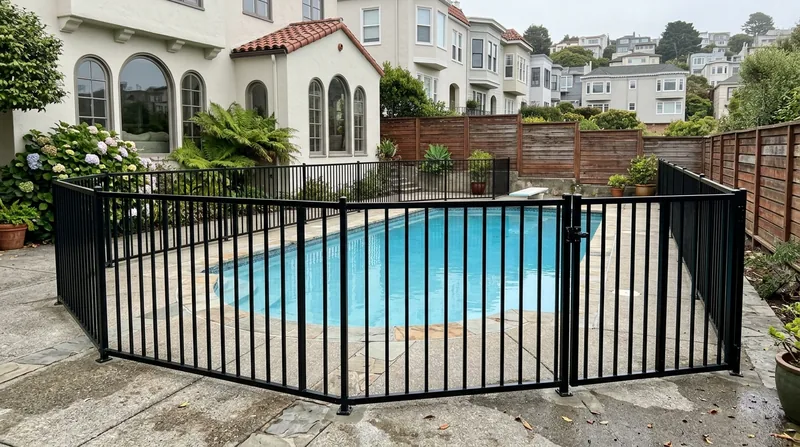




Pool fence installation in San Francisco requires more than standard fencing knowledge. The Bay's salt air, fog drip, and winter rains demand hardware and materials built to resist corrosion, while California state law and local building codes set strict barrier heights and gate-closure standards. On the narrow rear yards of Noe Valley, Bernal Heights, and the Outer Sunset, pool barriers must fit tight lots, navigate sloped terrain, and handle stepped installations where ground levels drop sharply. We install aluminum, mesh, and glass pool barriers to code, with self-closing, self-latching gates that hold up to the marine environment. Before we set a single post, we walk the requirements with you so your pool meets safety standards and your neighbors' property lines stay clear.
Why Pool Barrier Code Matters in San Francisco Backyards
California state law requires all residential pools and spas to be surrounded by a pool safety fence that meets specific height, gate-closure, and access standards. The rules exist to prevent unsupervised entry by children and to reduce drowning risk. In San Francisco, where many homes sit on steep lots with limited yard space, a properly installed barrier is the difference between a compliant pool and a code violation that blocks sales, delays permits, or triggers liability exposure.
The barrier code applies whether your pool is new or you're upgrading an older installation. Local building departments enforce these standards, and inspectors check gate operation, post spacing, and material integrity before signing off. A self-closing pool gate that fails to latch or a fence panel with gaps larger than code allows can trigger a failed inspection and costly rework.
- Barrier height in California is typically 48 inches measured from the finished ground level on the pool side.
- Gates must be self-closing and self-latching, with a maximum gap of 0.5 inches between the gate and the post or frame.
- Vertical pickets or horizontal slats cannot exceed 4 inches in width to prevent a child's head from passing through.
- All hardware must resist corrosion in the salt-air environment of the Bay Area.
- Post spacing and concrete depth are set to prevent leaning or racking under wind and ground movement.
A mesh pool fence or aluminum barrier installed to code gives you peace of mind and a clear inspection record.
Key info: California pool barrier standards are enforced by your local building department. In San Francisco, the Department of Building Inspection reviews pool barrier installations. For exact code language and inspection procedures, visit sfdbi.org or contact your local building department before design or installation.
How We Install Pool Barriers on San Francisco Lots
Pool barrier installation on San Francisco's hillside lots requires careful planning. Many homes in Diamond Heights, Twin Peaks, and the Excelsior sit on terraced or sloped ground, which means the fence may need to step down as elevation changes, or posts may be set at different depths to maintain a level or properly racked barrier. We start by confirming the pool location, measuring the yard perimeter, and identifying any utilities before we dig. A California 811 utility locate is required by law before any post hole is set, and we file that request before work begins.
We then walk the site with you to confirm gate placement, material choice (aluminum, mesh, or glass), and any HOA or deed-restriction rules that may apply to your neighborhood. Once we have your approval and the utility locate is marked, our crew sets posts in concrete, installs horizontal rails, attaches pickets or mesh panels, and hangs the gate with self-closing, self-latching hardware rated for the Bay's salt air. We test the gate closure and latch operation before we leave the site.
- We obtain a free California 811 utility locate to identify buried gas, electric, water, and telecom lines before digging.
- Posts are set in concrete at depths that prevent leaning on soft fill or sandy soil common in the Outer Sunset and western neighborhoods.
- On sloped ground, we step or rack the fence to maintain code-compliant height and keep panels plumb and square.
- Gates are hung with commercial-grade hinges and self-closing operators that resist salt-air corrosion.
- We confirm gate operation meets code before final inspection and sign-off.
The entire process typically takes 2 to 4 days depending on lot size and terrain. For a detailed breakdown of how we handle your specific site, call us at (628) 241-1526 for a free estimate. We also handle gate installation and repair if you need to upgrade or repair an existing barrier gate.
Example: A Bernal Heights home with a pool on a steeply sloped rear yard required a stepped barrier that dropped 18 inches over the 30-foot run. We set posts at the proper depth on each tier, installed horizontal rails to follow the slope, and hung a self-closing gate at the access point. The barrier met code height on all sections and passed inspection on the first review.
Pool Fence Installation Methods: Aluminum, Mesh, and Glass
| Barrier Type | Description | Best for San Francisco Yards |
|---|---|---|
| Aluminum Picket or Slat | Powder-coated aluminum posts, rails, and pickets or horizontal slats. Lightweight, corrosion-resistant, and available in colors that complement modern and traditional homes. | Visible from the street or neighboring properties. Durable in salt air. Requires no staining or sealing. |
| Mesh Pool Fence | Removable or permanent mesh panels attached to aluminum or powder-coated steel frames. Mesh is typically vinyl-coated and UV-resistant. Easy to open and close for pool access. | Minimal sight-line obstruction. Resists wind on exposed lots. Removable mesh pools are popular for temporary seasonal barriers or when yard access is needed. |
| Glass or Acrylic Panels | Tempered glass or acrylic panels in aluminum frames. Maintains views of the pool and yard while providing a code-compliant barrier. Requires regular cleaning to stay clear. | Homes where pool views are a design priority. Modern Marina and St. Francis Wood homes. Salt air requires stainless steel hardware and regular maintenance. |
| Aluminum Gate with Mesh or Slats | Self-closing, self-latching gate in aluminum frame with either mesh infill or solid aluminum slats. Hardware is stainless or powder-coated for corrosion resistance. | Access gates at all entry points. Meets code-required closure and latch standards. Operates smoothly on sloped or uneven ground. |
Each material choice offers different durability and aesthetic profiles. Aluminum and mesh resist the fog drip and salt air that corrode steel and damage wood finishes. Glass maintains sightlines but requires more frequent cleaning. We help you choose the right method based on your pool location, yard size, neighborhood aesthetic, and budget.
Pool Fence Installation Cost in San Francisco: What to Expect
Pool barrier costs in San Francisco typically start at $34 per linear foot for aluminum or mesh installation, including posts, rails, pickets or panels, hardware, and labor. A 100-foot barrier around a standard residential pool runs roughly $3,400 to $4,500 before permits or site-specific upgrades. The final price depends on several factors: lot slope and terrain, gate placement and type, material choice (aluminum versus mesh versus glass), and whether existing fence can be incorporated or must be removed and replaced.
Sloped or stepped installations on hillside lots in Twin Peaks, Diamond Heights, or Bernal Heights typically cost more because posts must be set at different depths and panels racked or stepped to follow grade. Soft soil in the Outer Sunset or bay fill on the east side may require deeper post holes and additional concrete. Salt-air environments demand stainless or powder-coated hardware, which adds to material cost but ensures the gate and hardware last 10 to 15 years without rust or corrosion.
We recommend getting 2 to 3 estimates from local contractors so you can compare material choices, labor approaches, and warranty terms. A detailed estimate should break out post and rail materials, gate hardware, labor, and any permit or utility-locate fees. For a free estimate tailored to your specific pool and yard, call us at (628) 241-1526 or visit our pricing page for more details on what affects the final cost.
Pool Fence Installation Near Me: What San Francisco Homeowners Should Know When Hiring a Contractor
Hiring a fence contractor for pool barrier work means checking three things: insurance and workers' compensation coverage, understanding how fence licensing works in California, and confirming the contractor knows local code and HOA rules. California requires a C-13 Fencing Contractor license for any fence project over $1,000 in combined labor and materials or any job that requires a building permit. Pool barriers almost always require permits because they are code-mandated safety structures, so your contractor must be licensed.
Fully insured contractors carry general liability and workers' compensation insurance. Request a certificate of insurance showing coverage limits before work begins. Your homeowner's policy does not cover contractor injuries, so this step protects you. Also ask whether the contractor has experience with San Francisco's specific challenges: sloped terrain, fog-drip rot, salt-air corrosion, and narrow rear yards where fence lines are shared with neighbors.
Check references from recent pool barrier jobs in your neighborhood. Ask whether the contractor obtained the California 811 utility locate, whether the job passed inspection on the first try, and whether the gate hardware has held up to the marine environment. If your home is in an HOA or has deed restrictions, confirm that the contractor understands your community's architectural rules before design work begins. Many San Francisco neighborhoods have height, material, and color restrictions that must be approved before installation.
- Request a certificate of insurance showing general liability and workers' compensation coverage at or above your state's minimum.
- Ask for references from 2 to 3 pool barrier jobs in San Francisco or nearby Peninsula communities completed in the last 2 years.
- Confirm the contractor will obtain the free California 811 utility locate before digging any post holes.
- Check whether your HOA or deed restrictions require approval of fence height, material, or color before work begins.
- Get a written estimate that breaks out materials, labor, permits, and any site-specific costs so you can compare multiple bids fairly.
For a free consultation and estimate, contact us at (628) 241-1526. We serve San Francisco, Daly City, South San Francisco, San Mateo, and surrounding Peninsula communities with fully insured pool barrier installation and repair.
Pool Fence Installation in San Francisco: Pricing Guide
| Service | Price | Details |
|---|---|---|
| Aluminum or Mesh Pool Barrier | Starting at $34/ft | Posts, rails, pickets or mesh panels, self-closing gate, hardware, and labor installed to code |
| Stepped or Sloped Terrain Installation | Starting at $38/ft | Hillside lots requiring stepped panels, deeper post holes, or racked installation to follow grade |
| Glass or Premium Acrylic Panel Barrier | Starting at $45/ft | Tempered glass or acrylic panels in aluminum frames, stainless hardware, higher material and installation cost |
| Gate Replacement or Upgrade | Starting at $1,200 | Self-closing, self-latching gate with corrosion-resistant hardware, sized to your opening and installed to code |
| Site-Specific or Complex Jobs | On estimate | Soft soil requiring deeper posts, existing barrier removal, utility complications, or non-standard lot geometry |
| Free Estimate and Consultation | No charge | Response within 24 hours at (628) 241-1526, includes site walk, code review, and material recommendations |
Indicative pricing, the exact cost depends on square footage, finish, and site access. Free personalized estimate within 24h at (628) 241-1526.


