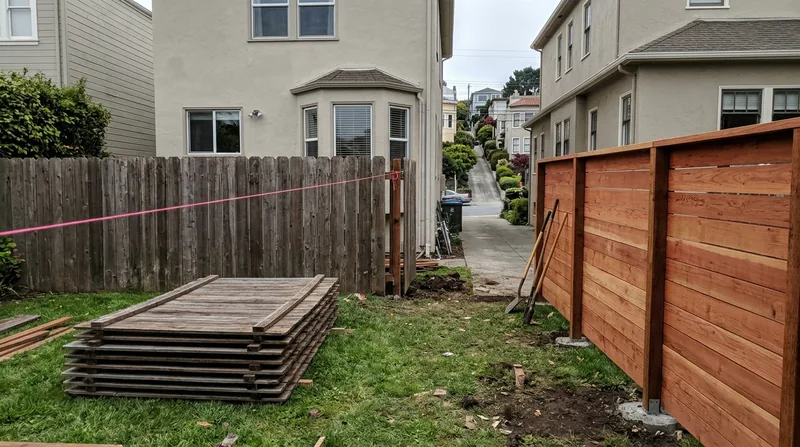




San Francisco's dense neighborhoods, steep hillsides, and narrow rear yards mean most fences are shared property-line barriers running between neighbors on tight 25-foot-wide lots. The city's cool, damp winters and salt-laden Pacific air create the conditions that break fences fastest: fog drip and wet soil that rot posts at the ground line, rust that eats galvanized hardware and iron, and wind that racks tall panels on exposed slopes. When a fence replacement in San Francisco becomes necessary, you're often looking at a full tear-out and rebuild, or a straight removal if that's all the scope demands. We handle complete haul-away, reuse sound materials where they exist, and quote repair versus full replacement side by side so you can decide with real numbers in hand.
Why Fence Replacement Matters in San Francisco's Tight Neighborhoods
Redwood and cedar privacy fences dominate San Francisco's older neighborhoods, from the Haight to Noe Valley to Bernal Heights. These materials handle the marine layer well but fail predictably when posts settle into soft bay fill or dune sand, when moisture pools at the base, or when wind stress racks the frame. A leaning fence isn't just an eyesore; it compromises your property line, creates disputes with neighbors, and signals that structural failure is close behind. Vinyl and modern horizontal-slat redwood fences perform better on steep lots, but even they need removal and reset when the underlying posts have rotted or the frame has shifted.
- Rotted posts at the ground line are the dominant failure mode in San Francisco's wet winters and cannot be repaired once the rot reaches the concrete footing.
- Racked or leaning panels indicate that posts have shifted or settled, and replacement is the right choice when repair cost exceeds 40 to 50 percent of a new fence's price.
- Rusted hardware and corroded iron fencing accelerate failure and create safety hazards, especially on stairs and entry gates in salt-air neighborhoods like the Outer Sunset and Pacifica.
- Neighbor disputes over shared fence boundaries are resolved faster and more fairly when both parties agree to a complete removal and reinstall on the agreed line.
Removing an old fence cleanly and rebuilding it right saves money, eliminates disputes, and gives you a fence that will last another 15 to 25 years.
Local insight: In neighborhoods like St. Francis Wood and Pacific Heights, shared rear-yard fences often have easement or covenants that govern height, material, and maintenance cost. A full replacement is a good time to verify those rules with the property deed and your HOA, if one exists, so the new fence meets all standards on day one.
For more information on what makes a fence fail and when repair is still an option, visit our fence repair service page.
How We Handle Fence Removal and Replacement on San Francisco's Steep Lots
San Francisco's topography means most fences are stepped down slopes or racked to fit uneven terrain. Removal must account for that complexity: posts set in concrete need careful extraction, old boards and rails go to recycling or reuse, and the site must be cleared to bare ground so a new fence can be set plumb and level. We start with a site survey, identify any utility lines using a California 811 locate, and quote the full removal cost before we touch a tool.
- We excavate post holes to proper depth, set new posts in concrete on undisturbed soil or compacted fill, and ensure plumb and spacing meet code.
- We install new rails, boards, and caps using pressure-treated pine or cedar for privacy fences, galvanized or powder-coated hardware for durability in the salt air, and proper bracing to prevent sag and racking.
- We verify the fence sits on your property line and complies with San Francisco or county setback rules before the final inspection.
The entire process, from removal to a ready-to-stain fence, typically takes 5 to 10 business days depending on lot size and access.
Example: A 60-linear-foot rear-yard fence in Glen Park or the Excelsior, stepped to follow a steep slope, with old redwood posts rotted at the ground line and a neighbor on the other side, requires careful coordination of the removal, temporary bracing if the neighbor's side must be preserved, and a reset on proper footings. We handle the logistics so both properties end up with a solid fence and no dispute.
If your fence is still sound but needs cosmetic work, explore our fence staining and restoration service before committing to a full replacement.
Removal and Replacement Methods: When to Use Each Approach
| Approach | Description | Best For |
|---|---|---|
| Full tear-out and rebuild | Remove all posts, rails, and boards; excavate to bare ground; set new posts in concrete; install new frame and pickets or boards. | Rotted posts, racked frames, material changes (wood to vinyl), and neighbor disputes over the line. |
| Removal only | Take out the entire fence and haul away debris; leave the property open for future installation or a different material. | Estate sales, property subdivision, or when you want to plan the new fence later or hire a different contractor. |
| Post replacement with frame reuse | Replace rotted or leaning posts while keeping sound rails and boards in place; requires temporary bracing and careful excavation. | Fences with solid boards or pickets but compromised posts; common in Noe Valley and Bernal Heights where redwood frames are often sound. |
| Stepped or racked reinstall | Remove and reset the fence along a slope, maintaining the stepped or racked profile to match the terrain. | Hillside properties in Twin Peaks, Diamond Heights, and Glen Park where the fence must follow steep grade changes. |
| Chain link or vinyl replacement | Remove old chain link or vinyl panels and hardware; reset new mesh or vinyl boards on existing posts if sound, or replace posts and frame. | Industrial lots in Bayview and Dogpatch, or when upgrading from chain link to vinyl for appearance and durability. |
Each approach has a different cost profile. A full rebuild costs more upfront but lasts longer and eliminates future disputes. Removal only is the cheapest option if you plan to rebuild later with a different material or contractor.
Fence Replacement and Removal Cost in San Francisco: What to Expect
Fence replacement and removal costs in San Francisco start at $2,400 for a straightforward 40 to 50-linear-foot rear-yard fence on level ground with easy access. That figure includes full removal, site prep, new posts set in concrete, new rails and boards or panels, and hardware. The cost rises quickly when the lot is steep, when access is limited (narrow alley, gates, trees), when you're upgrading materials (wood to vinyl), or when neighbor coordination is required.
Factors that move the price up include:
- Lot slope and terrain: Stepped or racked fences on steep San Francisco hillsides take longer to measure, layout, and install than level runs.
- Post condition and depth: Posts set in concrete on soft bay fill or dune sand may need deeper excavation and additional bracing to prevent future settling.
- Material choice: Pressure-treated pine is the baseline; cedar costs more; vinyl or aluminum costs significantly more but lasts 30 to 40 years.
- Access and site constraints: Narrow alleys, overhead wires, mature trees, and neighboring properties all add time and careful handling to the job.
- Neighbor involvement: Shared fences that require coordination with the neighbor on the other side may need temporary bracing or phased work, increasing labor.
A typical 60-linear-foot privacy fence in Noe Valley or Pacific Heights, stepped to a moderate slope with new cedar boards and galvanized hardware, runs $3,200 to $4,500. A vinyl fence of the same length costs $4,500 to $6,500. A full-tear-out and replacement of a 100-linear-foot run with complex terrain or material change can exceed $8,000.
The best way to get a real number is to request a free estimate. We measure the fence, assess the soil and terrain, note any utilities or hazards, and quote removal, new construction, and any site prep as separate line items so you understand where the cost comes from. Visit our pricing page for detailed breakdowns and typical costs by material and location.
What to Look for When Hiring a Fence Contractor Near San Francisco
Fence replacement and removal is regulated work in California. Before you hire, verify that the contractor carries full insurance, understands local permit requirements, and can explain how fence licensing works in your city or county. San Francisco, Daly City, Oakland, and other Bay Area jurisdictions each have their own rules on fence height, setbacks, and whether a permit is required. Some communities also have HOA or deed restrictions that govern material and color. A good contractor will ask about these rules before quoting, and will help you navigate them.
- Confirm that the contractor carries general liability insurance and workers' compensation coverage, and ask for a certificate of insurance before work begins.
- Understand that California requires a C-13 Fencing Contractor license for projects that reach $1,000 in combined labor and materials or require a building permit, and that the law is enforced by the Contractors State License Board; verify the contractor's status at cslb.ca.gov.
- Get written estimates from at least two contractors, and compare what's included in each quote: removal, haul-away, post depth, concrete, board grade, hardware, and labor.
- Check references from recent jobs in your neighborhood, especially if the fence is stepped or on a steep lot, and ask about timeline and cleanup.
- Verify permit requirements with your local building department or planning office before signing a contract, and clarify who is responsible for obtaining the permit and paying the fee.
- If your property is in an HOA or has deed restrictions, review those documents with the contractor and confirm the new fence meets all standards before construction starts.
The cheapest bid is rarely the best value. A contractor who takes time to measure, ask questions, and explain the work is more likely to deliver a fence that lasts and keeps you out of disputes with neighbors.
Ready to move forward? Contact us for a free estimate or call (628) 241-1526 to discuss your project and get a timeline.
Fence Replacement & Removal in San Francisco: Pricing Guide
| Service | Price | Details |
|---|---|---|
| Removal only | Starting at $1,200 | Full tear-out and haul-away of existing fence, site cleared to bare ground, no new installation included |
| Straightforward replacement (40-50 linear feet) | Starting at $2,400 | Removal, new posts in concrete, new boards or panels, galvanized hardware, level terrain with good access |
| Stepped or racked fence on slope (60-80 linear feet) | Starting at $3,800 | Removal, stepped or racked installation to follow terrain, new posts and frame, common in hillside neighborhoods |
| Vinyl or upgraded material replacement (60+ linear feet) | Starting at $4,500 | Full removal, new vinyl panels or aluminum frame, longer lifespan and lower maintenance, complex terrain or access adds cost |
| Complex or large-scale project (100+ linear feet, multiple materials, neighbor coordination) | On estimate | Detailed site survey required to assess terrain, utilities, access, and material changes before a firm price can be quoted |
| Free estimate and consultation | Free | Response within 24 hours at (628) 241-1526, includes site visit, measurement, and written quote with no obligation |
Indicative pricing, the exact cost depends on square footage, finish, and site access. Free personalized estimate within 24h at (628) 241-1526.


