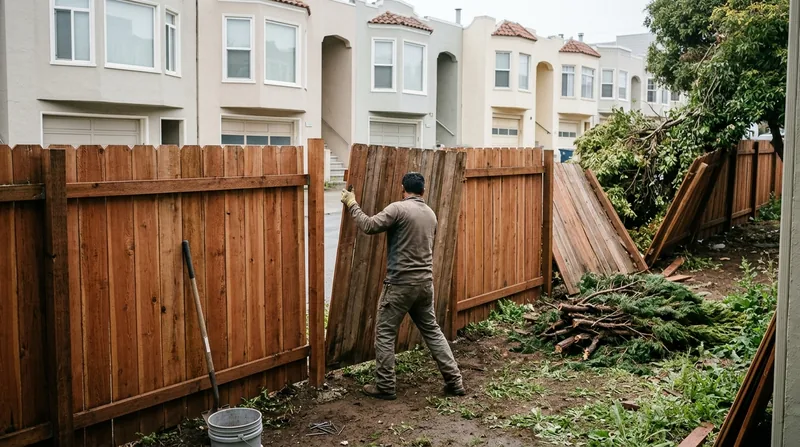




Winter atmospheric rivers and Pacific gales test every fence in San Francisco, and when a cypress limb crashes down or a section of redwood privacy fencing falls, you need fast, honest repair that matches your existing line and materials. Storm damage fence repair in San Francisco is not a rare event. The city's hilly terrain, narrow rear-yard lots shared between neighbors, and decades-old wood posts set in damp ground create conditions where wind, heavy rain, and tree failure take down sections regularly. We assess the damage, document it with photos and a written estimate to support your insurance claim, and rebuild the same fence stronger. Most jobs happen in winter and early spring, when the rain comes hardest and the ground is too soft to hold tired posts.
Why Storm Damage Fence Repair Matters in San Francisco's Dense Neighborhoods
San Francisco's Victorian and Edwardian row houses sit on 25-foot-wide city lots where rear fences are property-line structures shared with neighbors. A fallen section leaves you liable for safety, exposes your yard to the street, and often triggers a dispute over who pays to rebuild. The city's cool, wet winters keep wood damp year-round, rotting posts at the ground line where they sit in soil. Salt air from the Pacific corrodes hardware and iron. Tall cypress, eucalyptus, and Monterey pines shed limbs in wind. When a fence fails, the clock starts on insurance documentation, neighbor communication, and repair scheduling.
- We photograph and measure damage the same day you call, capturing the fallen section, the remaining posts, and the ground conditions.
- We document the failure mode so your insurance adjuster understands whether it was wind, rot, tree impact, or ground settlement.
- We provide a written estimate with material specs and labor so you have proof of the repair cost for your claim.
- We work from the existing fence line and match the original material, height, and detail so the repair is invisible to the street.
Fast documentation and honest repair guidance save time and money when you file a claim.
Key info: In San Francisco, rear-yard fences between neighbors are often owned jointly or governed by deed restriction. Before you repair, check your property survey or deed to confirm responsibility. If you do not have a survey, we work from the fence line you identify, and we recommend you verify the boundary with a licensed land surveyor if the cost or dispute is significant. See the San Francisco Department of Building Inspection website for setback and material rules that may apply to your lot.
How We Repair Storm Damage: Assessment, Documentation, and Rebuild
Storm damage repair starts with a site visit to measure the fallen section, inspect the remaining posts and rails, and understand why the fence failed. We look for rot at the ground line, rust in hardware, loose posts that have shifted in soft bay-fill soil, or tree damage. We take photos and note the materials, age, and condition so your insurance adjuster has a clear picture. Then we give you a written estimate with a cost to remove the damaged section, set new posts in concrete, and install new rails and boards to match the existing fence.
- We call 811 to locate buried utilities before we dig post holes, a legal requirement in California.
- We remove the fallen section and any damaged posts, hauling debris off-site.
- We set new posts in concrete, spaced and aligned to match the original fence, racked (stepped down) if the lot is sloped.
- We install new rails and boards in the same species and style, or in the material you choose if you want to upgrade.
- We cap and trim the repair so it matches the rest of the fence and sheds water.
- We leave the site clean and the fence secure.
Repair typically takes one to three days depending on the section length and soil conditions. See our fence repair page for more detail on other common damage.
Local example: A Noe Valley homeowner's old redwood privacy fence was hit by a fallen cypress limb during a winter storm. The top three boards split, and two posts cracked. We removed the damaged section (about 8 linear feet), reset two new 4x4 posts in concrete, installed new 2x8 redwood boards to match the existing fence, and capped the top. The repair cost $1,200 and took one day. The homeowner's insurance covered $900 after the deductible, and the repair was invisible from the street.
| Repair Approach | What It Means | Best For |
|---|---|---|
| Section replacement | Remove fallen boards and posts, set new posts in concrete, install new rails and boards in the original material and style. | Tree damage, wind damage, rot at the ground line. Most common storm repair. |
| Post reinforcement | Dig out a leaning post, reset it plumb in concrete, brace it with anti-sag rods if needed. | Posts that have shifted in soft soil but rails are still sound. Faster than full replacement. |
| Board replacement only | Remove and replace damaged boards while posts remain in place and concrete-set. | Split or cracked boards, broken pickets. Posts are solid and plumb. |
| Full section removal and rebuild | Take out the entire fallen run, inspect the adjoining posts, and rebuild to code and the original spec. | Large sections down, multiple posts damaged, or rot spreading. Ensures the repair lasts. |
Storm Damage Fence Repair Cost in San Francisco: What to Expect
The cost of storm damage repair depends on the length of the fallen section, the materials (redwood, cedar, pressure-treated pine, chain link, or vinyl), soil conditions, and whether posts are rotted or just displaced. A free damage assessment gives you a realistic number. Start with a call to (628) 241-1526 or a photo and description of the damage. We measure the fallen section, inspect the remaining posts and footings, and give you a written estimate with a cost range.
Small repairs (4 to 8 linear feet, one or two posts) typically run $800 to $1,500. Larger sections (12 to 20 linear feet, three to four posts) run $1,500 to $3,000. If the soil is soft bay fill on the east side or dune sand in the Outer Sunset, post setting costs more because we dig deeper and use more concrete. If you want to upgrade the material (e.g., replace old pressure-treated pine with new redwood or vinyl), the cost rises. Getting two or three estimates is smart so you can compare scope, material, and timeline.
See our pricing page for a detailed breakdown of repair costs by section size and material.
What to Look for When Hiring a Fence Contractor Near San Francisco
When you call a fence contractor to repair storm damage, ask for proof of general liability and workers' compensation insurance. Request a certificate of insurance naming you as additional insured. Ask the contractor whether your repair needs a permit. If it does, the contractor must hold the license or bring in a licensed general contractor to oversee the work.
Ask for references from recent storm repairs. Ask whether the contractor uses 811 utility locates before digging. If the repair touches a tree or involves a protected species, ask whether a permit from the Department of Building Inspection is required. If you live in an HOA or master-planned community, check your architectural guidelines for fence material, height, and color rules before you schedule the repair. Call us at (628) 241-1526 to discuss your damage and get a free estimate, or visit our contact page to request a same-day callback.
Storm Damage Fence Repair in San Francisco: Pricing Guide
| Service | Price | Details |
|---|---|---|
| Free damage assessment | No charge | Same-day or next-day site visit, photos, measurement, and written estimate for your insurance claim |
| Small section repair (4 to 8 linear feet, one to two posts) | Starting at $800 | Includes post removal, concrete setting, new rails and boards, matching existing material and style |
| Medium section repair (12 to 20 linear feet, three to four posts) | Starting at $1,500 | Full section rebuild with soil assessment, anti-sag bracing if needed, and color or stain match to existing fence |
| Large section or multiple damage (over 20 linear feet or complex soil) | On estimate | Soft bay fill or dune sand, tree removal, or material upgrade requires on-site assessment and detailed scope |
| Material upgrade (e.g., pressure-treated to redwood or vinyl) | Material cost plus labor | Redwood and cedar cost more than pressure-treated pine; vinyl costs more upfront but lasts longer |
| Travel and utility locate | Included | No separate mileage or call-out fee in San Francisco and surrounding areas; 811 locate required by law |
Indicative pricing, the exact cost depends on square footage, finish, and site access. Free personalized estimate within 24h at (628) 241-1526.


