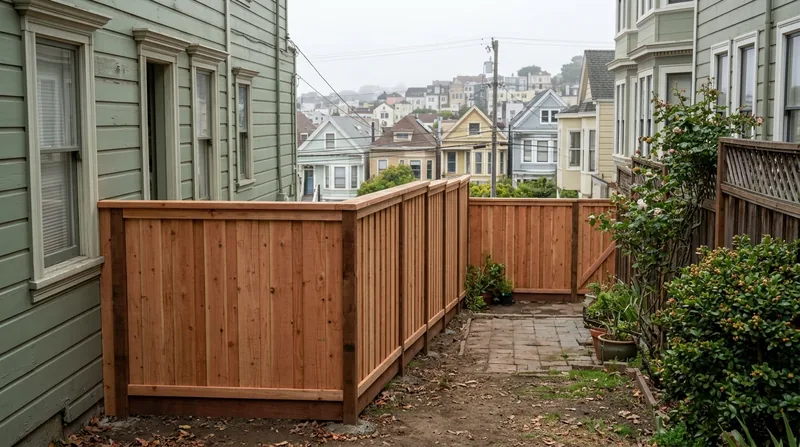




Wood and privacy fence installation in San Francisco means building a fence that stands up to fog drip, salt air, and the tight rear yards of Noe Valley, the Haight, and Bernal Heights. San Francisco's classic 6-ft redwood or cedar privacy fence sits on narrow 25-ft-wide lots, often stepped down slopes, and shares property lines with neighbors. The real work here is setting pressure-treated posts in concrete deep enough to resist the soft bay fill and dune sand that let posts lean, and choosing redwood or cedar boards that shed moisture and resist rot at the ground line where fog and winter rain do the damage. We tell you honestly when redwood is worth the cost and when cedar delivers the same durability for less.
Why Privacy Fences Matter in San Francisco's Hillside Neighborhoods
San Francisco's Victorian row houses in Pacific Heights, the Marina, and Bernal Heights sit shoulder to shoulder, with rear yards that are narrow, steep, and shared. A privacy fence does three jobs at once: it blocks sight lines from neighbors, it holds back loose sand and soft fill on slopes, and it keeps wind-driven fog and salt spray from coating the back of the house. Redwood and cedar boards weather to soft silver, but they only last if the posts underneath stay dry. Wet winters and marine air mean posts rot at the ground line faster than they would inland, and a fence that leans or sags loses its privacy and its structural value.
- A 6-foot privacy fence blocks sightlines and wind in dense neighborhoods and meets most San Francisco setback and height rules.
- Board-on-board installation staggers boards on both sides of the rails, blocking views from every angle and adding visual interest.
- Pressure-treated posts set in concrete resist rot and hold the fence plumb on uneven terrain and soft ground.
- Cedar and redwood are naturally rot-resistant and age to a soft gray without stain, fitting the aesthetic of older San Francisco homes.
- Stepped installation on slopes keeps the fence level and prevents gaps that undermine privacy and durability.
A well-built privacy fence solves the real problem: moisture at the ground line is what breaks fences here, not wind or age alone.
Key info: San Francisco's Planning Code sets fence height at 6 feet in rear yards and 3.5 feet in front yards for most lots. Corner-visibility requirements may reduce height near intersections. Rules vary by neighborhood and are stricter in historic districts. Check the San Francisco Planning Department before you build, especially if your home is in a protected area.
How We Build a Privacy Fence in San Francisco: From Survey to Finished Boards
Privacy fence installation on San Francisco's steep lots and shared property lines requires careful planning. We start with your survey or the line you identify, call for a California 811 utility locate to mark underground lines, and then set posts in concrete at 6-foot intervals, racked or stepped to follow the slope. Boards go on as either side-by-side, board-on-board, or horizontal slat, depending on privacy need and your home's style. The whole job takes longer on slopes because each section must be leveled and braced, and concrete curing takes time. Redwood boards are milled thicker and tighter than cedar, which costs more but ages more evenly; cedar is a smart budget call if you are willing to let it weather naturally.
- We verify the property line using your existing survey and mark the fence line with you before any digging begins.
- California law requires a utility locate before we dig post holes, so we call 811 to mark gas, electric, water, and telecom lines.
- We dig post holes 3 feet deep, set 4-by-4 pressure-treated posts in concrete, and allow concrete to cure fully before hanging boards.
- We cut and fit redwood or cedar boards to your chosen pattern, nailing or screwing them to the rails with galvanized fasteners.
- On slopes, we step or rack the fence so each panel sits level and the bottom edge follows the ground without large gaps.
The difference between a fence that lasts 15 years and one that lasts 25 is concrete depth, post spacing, and board choice, not the brand of nail.
Local example: A Noe Valley homeowner with a steep rear yard on soft fill chose redwood board-on-board at 6 feet, with posts stepped down the slope. Concrete set to 3 feet, and boards hung on galvanized hardware. Cost ran $38 per linear foot installed. The fence stayed plumb through three winters of fog and rain because the posts were deep and the concrete was poured right. We can help you plan the same way. Call (628) 241-1526 for a free on-site estimate.
For other fence needs, we also offer fence repair when an existing fence can be salvaged, and fence post repair and replacement if only the posts have rotted.
Privacy Fence Installation Methods: Board-on-Board, Horizontal Slat, and Stepped Layouts
| Approach | Description | Best for |
|---|---|---|
| Board-on-Board | Redwood or cedar boards overlap on both sides of the rails, creating a solid barrier with no sightlines and a finished look on both sides. | Shared property-line fences where neighbors see both sides. Higher cost, maximum privacy. |
| Side-by-Side | Boards run vertically next to each other with no overlap, hung on rails. Fast to install, clean lines, one finished side. | Budget-conscious jobs where one side faces the neighbor and the other faces your yard. |
| Horizontal Slat | Thin horizontal boards create a modern look with subtle light gaps, softer privacy, and less wind load on steep slopes. | Contemporary homes and lots where partial privacy and visual interest matter more than a solid wall. |
| Stepped Installation | Each fence section sits level on a slope, with a vertical step between sections. Prevents gaps and racking, keeps posts plumb on uneven ground. | San Francisco's hillside lots in Bernal Heights, Twin Peaks, and Diamond Heights where terrain drops 2 feet or more across the fence line. |
| Racked Installation | Fence panels angle to follow the slope, with boards cut at an angle. Avoids steps and creates a continuous line, but leaves gaps at the bottom. | Gentle slopes where the grade change is less than 12 inches per 8-foot section and bottom gaps are acceptable. |
Stepped installation is the standard in San Francisco because our slopes are steep and our soft ground demands that posts stay plumb and concrete-set. Racked fences look sleek but leave gaps that wind and small animals can exploit, and they are harder to repair one panel at a time.
Wood and Privacy Fence Installation Cost in San Francisco: What to Expect
Privacy fence installation in San Francisco starts at $27 per linear foot for a basic side-by-side cedar fence with pressure-treated posts and concrete footings. Redwood costs more, typically $32 to $42 per linear foot, because the wood is thicker, tighter-grained, and more rot-resistant. Board-on-board doubles the board count, so add 20 to 30 percent to the base price. Stepped installation on slopes adds labor and may require custom cuts, so expect $35 to $50 per linear foot for a steep lot. Concrete depth, post spacing, fastener type, and site access all move the price: soft ground that requires deeper concrete, narrow alleys that slow delivery, or tree roots that block digging will push costs up. Getting 2 or 3 estimates is always smart because every lot is different.
For a 50-linear-foot fence around a typical Outer Sunset cottage lot, budget $1,350 to $2,100 depending on whether you choose cedar or redwood and whether the fence is stepped or level. A 100-linear-foot run in board-on-board redwood with stepped installation on a Bernal Heights slope could run $3,500 to $5,000. Travel is included in our service area, and we offer a free estimate with no obligation. Call (628) 241-1526 to discuss your project and get a realistic price based on your lot and your choice of wood and style.
Wood and Privacy Fence Installation Near Me: What San Francisco Homeowners Should Know When Hiring a Contractor
Hiring a fence contractor in San Francisco means checking three things: insurance, licensing, and references. California law requires a C-13 Fencing Contractor license for any fence job that reaches $1,000 in combined labor and materials or requires a building permit. That license is set by the state, not by us, and the contractor must carry a $25,000 bond. Get 2 or 3 estimates, ask each contractor for references from recent jobs in your neighborhood, and ask specifically whether they will handle permits and utility locates or whether you need to coordinate those yourself. If your home is in a historic district or a master-planned community with an HOA, check architectural guidelines before you hire, because some neighborhoods restrict height, color, and material. A good contractor will ask about these rules and help you navigate them.
- Verify that the contractor carries general liability and workers' compensation insurance and can show you a certificate of insurance.
- Ask whether the contractor will handle the California 811 utility locate or whether you need to call it yourself before digging starts.
- Get the estimate in writing with a breakdown of materials, labor, and timeline, and ask about payment terms and warranty.
- Check the San Francisco Planning Department website if your property is in a historic district or if the fence height or setback is unclear.
- If you have an HOA, ask for a copy of the architectural guidelines and confirm your fence design meets those rules before work begins.
A local contractor who knows San Francisco's lots, slopes, and weather will save you money and headaches by building a fence that actually lasts.
Key info: Fence licensing and permit rules vary by city in the Bay Area. San Francisco requires permits for most new fences over 3.5 feet in front yards and over 6 feet in rear yards. Daly City, South San Francisco, and San Mateo have different thresholds. We help coordinate permits with your local building department, and we always call 811 before we dig. Reach out to get a free estimate and we will walk you through the process for your specific lot.
Wood & Privacy Fence Installation in San Francisco: Pricing Guide
| Service | Price | Details |
|---|---|---|
| Cedar privacy fence, side-by-side, level ground | Starting at $27/ft | Pressure-treated posts in concrete, cedar boards, galvanized fasteners, standard 6-foot spacing on flat or gentle lots |
| Redwood privacy fence, board-on-board, any terrain | Starting at $38/ft | Pressure-treated posts set 3 feet deep, redwood boards overlap both sides, stepped or racked to follow slope, galvanized hardware |
| Horizontal slat fence, modern style, stepped on slope | Starting at $35/ft | Cedar or redwood thin slats, modern aesthetic, stepped installation for San Francisco hillsides, includes concrete and labor |
| Complex or large-scale installation | On estimate | Steep slopes, tree roots, limited access, custom cuts, or material special orders require an on-site evaluation before pricing |
| Travel and utility locate | Included | No separate mileage fee in San Francisco and surrounding areas; California 811 utility locate call is included in the estimate |
| Free estimate and consultation | Free | On-site visit, design review, material options, and written estimate with no obligation to book; response within 24 hours |
Indicative pricing, the exact cost depends on square footage, finish, and site access. Free personalized estimate within 24h at (628) 241-1526.


