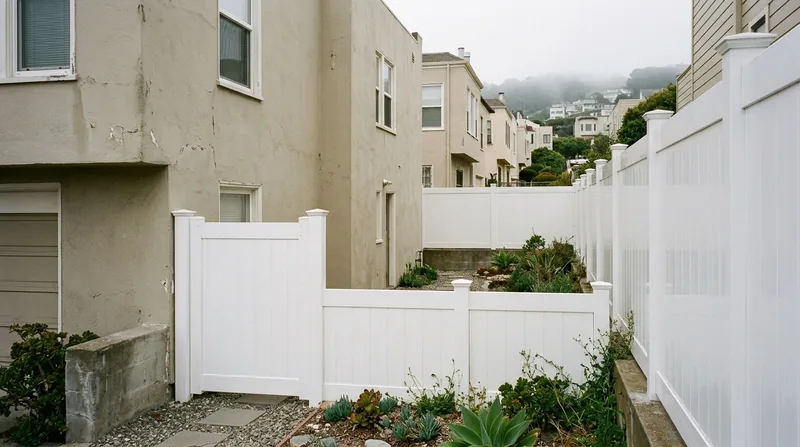




Vinyl & PVC fence installation in San Francisco offers homeowners a durable alternative to wood in a climate where fog drip, damp winters, and coastal salt air break down traditional materials within 10 to 15 years. San Francisco's dense neighborhoods, steep lots, and narrow rear yards between row houses in the Haight, Noe Valley, and Bernal Heights demand fencing that resists moisture rot at the post line, doesn't warp in the marine layer, and holds its color through decades of Pacific wind and salt spray. Vinyl and PVC panels manufactured to spec, set in concrete footings with correct post spacing, deliver low-maintenance privacy without the seasonal staining, warping, and replacement cycles that plague cedar and pressure-treated pine on the peninsula. This guide walks you through why vinyl works here, how we install it, what it costs, and what to look for when hiring a contractor.
Why Vinyl Fencing Wins in San Francisco's Coastal Climate
Wood fences fail in San Francisco not because of frost or snow, but because of relentless moisture. Fog drip saturates posts at the ground line for weeks at a time, especially in the Outer Sunset, Outer Richmond, and western neighborhoods where marine layer hangs thick. Winter rains keep soil around footings wet for months. Redwood and cedar heartwood resist decay longer than pressure-treated pine, but neither stays dry enough to avoid rot in our climate. Salt air from the Pacific corrodes galvanized hardware and accelerates rust on metal bracing. Vinyl and PVC panels shrug off all three: no rot, no rust, no warping.
- Vinyl panels absorb no water and resist moisture damage at the post line where wood fails fastest.
- PVC material does not warp, cup, or split under the temperature swings and humidity cycles of San Francisco's marine climate.
- Vinyl requires no staining, sealing, or annual maintenance to hold its appearance through fog and salt air.
- Manufacturer warranties on vinyl fencing cover material defects for 20 to 30 years, far longer than the typical wood fence lifespan here.
- Vinyl can be installed stepped or racked on the sloped lots common in Glen Park, Diamond Heights, and the Excelsior without the structural stress that causes wood to fail early.
These advantages make vinyl a sensible choice for homeowners who want to install once and not rebuild the fence every 12 to 15 years.
Key info: In neighborhoods like Pacific Heights and St. Francis Wood, many homeowners have switched from redwood privacy fences to vinyl after one or two replacement cycles. The upfront cost is higher, but the total cost of ownership over 30 years is lower when you factor in zero maintenance, no staining, and no replacement labor.
How Vinyl & PVC Fence Installation Works: From Survey to Finish
Vinyl fence installation in San Francisco follows the same fundamentals as wood installation, with one critical difference: post spacing and concrete footings must be exact. Vinyl panels are manufactured to specific dimensions. If posts are spaced incorrectly or set too shallow, panels won't fit, or worse, they'll rack and twist under wind load on the exposed slopes around Twin Peaks and Bernal Heights. Our process starts with a site walk, a call to 811 for utility locates (required by California law before any digging), and a clear agreement on the fence line with the property owner.
- We locate the property line from your existing survey and mark the fence run with chalk or string.
- California 811 utility locates mark gas, electric, water, and sewer lines so post holes avoid underground hazards.
- We dig post holes 30 inches deep on level ground, deeper on slopes, and set posts in concrete footings that cure for 24 hours before panel installation.
- Vinyl panels slide onto aluminum or steel rails bolted to the posts, with no nails, screws, or exposed fasteners that rust or loosen.
- On sloped lots common across San Francisco, we install panels stepped down the hill or racked to follow the grade, with bracing and hardware sized for wind load.
- Cap and trim pieces finish the top and conceal fasteners, giving a clean, maintenance-free appearance that lasts decades.
The entire process takes 2 to 5 days depending on the length of the fence, slope, soil conditions, and whether existing fence removal is needed.
Example: A 60-foot vinyl privacy fence installation in the Parkside neighborhood, replacing a rotted redwood fence on a gentle slope, typically takes 3 to 4 days from utility locates through concrete cure and panel installation. If the lot is terraced or steep, like many homes near Twin Peaks, we install stepped panels and may need an extra day for bracing and hardware.
For more information on how we approach fence installation on San Francisco's varied terrain, see our wood privacy fence installation page, which covers the site assessment and design process that applies to vinyl as well.
Vinyl & PVC Fence Installation Methods: Which Approach Fits Your Lot
| Approach | Description | Best for |
|---|---|---|
| Posts set in concrete footings | Posts dug 30 inches deep or deeper, set in concrete that cures 24 hours before rails and panels are installed. | All vinyl fence installations. Concrete-set posts resist settling and leaning on soft bay fill and dune sand common across San Francisco. |
| Stepped installation on slopes | Panels installed in horizontal runs down a sloped lot, with each section stepped down to follow the grade, no racking or angling of individual panels. | Lots in Glen Park, Portola, Diamond Heights, and near Twin Peaks where grade changes 2 feet or more across the fence run. |
| Racked installation on gentle slopes | Panels installed at an angle to follow a gentle slope without stepping, with anti-sag bracing to prevent racking under wind load. | Lots with grade changes under 2 feet across the run, common in the Mission, Excelsior, and Outer neighborhoods. |
| Vinyl privacy versus vinyl picket or ranch-rail | Privacy panels are solid vinyl, picket panels have open spacing, ranch-rail has 2 or 3 horizontal rails with no vertical pickets. | Privacy for rear yards and shared property lines. Picket for front yards. Ranch-rail for open sightlines and lower-cost perimeter fencing. |
Vinyl & PVC Fence Installation Cost in San Francisco: What to Expect
Vinyl fence installation costs more upfront than wood, but the total cost of ownership over 20 to 30 years is lower because vinyl requires no maintenance, no staining, and no replacement. In San Francisco, vinyl privacy fence installation starts at around $38 per linear foot for materials and labor on level ground with straightforward site access. That ballpark covers a manufacturer-spec vinyl panel, posts set in concrete footings, basic hardware, and professional installation. The actual cost per foot depends on several factors: whether the lot is level or steeply sloped, whether an existing fence needs removal first, soil conditions that affect digging depth and difficulty, and whether the fence run is open or blocked by trees, garages, or other structures that slow installation.
A 60-foot vinyl privacy fence on a level rear yard in the Mission or Parkside typically runs $2,200 to $2,400 installed. The same fence on a steep lot in Glen Park or near Twin Peaks, installed stepped or racked with extra bracing, may run $2,600 to $3,000. If an old redwood fence needs removal and hauling first, add $150 to $300 depending on its condition. Vinyl picket fencing runs 10 to 20 percent less than privacy panels because it uses less material. Vinyl ranch-rail is the lowest-cost vinyl option.
The best approach is to get 2 to 3 estimates from contractors who will walk the lot, identify slope, soil type, and access challenges, and give you a detailed price before work starts. See our full pricing guide for more detailed breakdowns by fence type and site condition.
Vinyl & PVC Fence Installation Near Me: What San Francisco Homeowners Should Know When Hiring a Contractor
Hiring a contractor for vinyl fence installation means checking three things: insurance and workers' compensation coverage, understanding how fence licensing works in California, and verifying that the contractor has experience installing vinyl on San Francisco's varied terrain. In California, fence work that reaches $1,000 in combined labor and materials or requires a building permit must be performed by a C-13 Fencing Contractor licensed by the California State Licensing Board (CSLB). Fence licensing here is set county by county, and some jurisdictions require permits for fences over a certain height or near property lines, while others do not. Always call your local building department before you start to learn the rules that apply to your address.
- Verify that the contractor carries general liability insurance and workers' compensation coverage, and ask for a certificate of insurance on request.
- Understand that California requires a licensed C-13 Fencing Contractor for fence work above $1,000, and ask whether your job scope triggers that requirement in your jurisdiction.
- Call your city or county building department to learn whether you need a permit, what fence height and setback rules apply to your lot, and whether HOA or deed restrictions govern material and color.
- Ask the contractor for references from recent vinyl fence installations in San Francisco neighborhoods similar to yours, especially if your lot is sloped or has challenging access.
- Get at least 2 detailed estimates that break down materials, labor, and any removal or site prep costs so you can compare apples to apples.
- Confirm that the contractor will call 811 for utility locates before digging and will install posts in concrete footings set to the depth required by soil conditions and grade.
San Francisco neighborhoods vary widely in their HOA rules and deed restrictions. Marina-style homes in St. Francis Wood, Westwood Park, and the Marina may restrict fence height, material, or color. Victorian row houses in the Haight and Noe Valley typically have no HOA but are subject to city height and setback rules. Cottage neighborhoods in Glen Park and Portola are usually free of restrictions. Always verify before you order materials or sign a contract.
Ready to get started? Contact us for a free estimate. We'll walk your lot, discuss your goals, and give you a detailed price with no obligation.
Vinyl & PVC Fence Installation in San Francisco: Pricing Guide
| Service | Price | Details |
|---|---|---|
| Vinyl privacy fence installation | Starting at $38/ft | Materials and labor for vinyl panels, posts set in concrete, basic hardware, and trim on level ground with standard access |
| Vinyl picket or ranch-rail fencing | Starting at $28/ft | Lower-cost vinyl options with less material and labor, ideal for front yards or open sightline perimeter fencing |
| Stepped or racked installation on slopes | Add 15 to 25 percent | Extra labor and bracing required for San Francisco's hillside lots, especially in Glen Park, Twin Peaks, and Diamond Heights |
| Existing fence removal and hauling | $150 to $300 | Depends on fence condition, length, and material; old redwood or chain link requires more labor and disposal |
| Travel and site assessment | Included | No separate call-out or mileage fee in San Francisco and surrounding service areas |
| Free estimate | No obligation | Response within 24 hours at (628) 241-1526; includes site walk, slope assessment, and detailed pricing breakdown |
Indicative pricing, the exact cost depends on square footage, finish, and site access. Free personalized estimate within 24h at (628) 241-1526.


