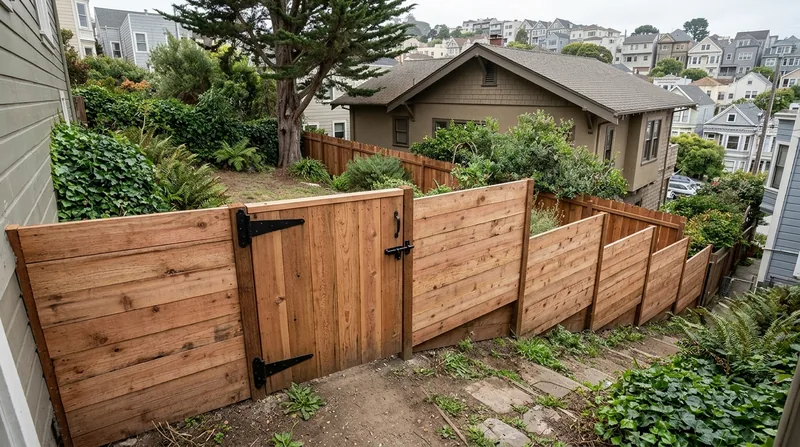




Gate installation and repair in San Francisco demands more than a standard hinge and latch. On the peninsula's steep lots, narrow rear yards, and fog-soaked winters, gates face relentless pressure: salt air rusts hardware and iron, damp ground rots wooden posts, and wind racks tall panels. Whether you need a new gate hung square on a side yard fence line, or a sagging wooden gate rebuilt with anti-sag bracing, the difference between a gate that swings free for years and one that binds or hangs crooked comes down to installation geometry, material choice, and hardware that actually holds. We build custom wood, metal, and security gates to specification, hang them right the first time, and repair the ones that drag or rust shut in San Francisco's salt air, usually the first part of any fence to fail.
Why Gates Fail in San Francisco: Fog, Salt Air, and Soft Ground
San Francisco gates fail for three reasons that rarely occur together anywhere else. The marine layer keeps wood damp year-round, pushing moisture into posts set at the ground line and rotting them from the base up. Salt spray from the ocean corrodes galvanized hardware, hinges, and iron fencing within a few seasons unless the metal is powder-coated or stainless. Soft bay fill and loose dune sand on the east and west sides of the city let fence posts lean and gates rack, throwing the frame out of square. A gate hung tight in October can bind by March.
- Rotted gate posts at the ground line require replacement of the post and rehang of the entire gate frame.
- Rusted hinges, latches, and hardware corrode in salt air and must be replaced with stainless or powder-coated steel to prevent seizing.
- Racked and sagging gates lose square as the fence line settles or wind loads flex the frame, and require anti-sag bracing or full rebuilds.
- Loose posts in soft ground allow the gate to lean, and may need concrete re-setting or deeper tamping to stabilize the fence line.
Understanding what breaks gates in San Francisco tells you what to fix first and how to build one that lasts.
Key info: In neighborhoods like the Outer Sunset, Parkside, and the Outer Richmond, where sandy soil and coastal exposure are most severe, wooden gates need stainless or powder-coated hardware and posts set in concrete below the frost line, even though San Francisco has no frost. The rot risk comes from moisture pooling at the ground, not freezing.
For more detail on post failure and replacement, see our fence post repair and replacement guide.
Additional guidance on permitting and regulations is available from the San Francisco Department of Building Inspection, which sets height, setback, and material standards for all fences and gates in the city.
How We Install and Repair Gates in San Francisco: Process and Materials
Gate installation starts with a site visit to measure the opening, assess the existing fence posts and frame, and determine whether the ground is stable enough to support the load. We mark post holes using a California 811 utility locate to avoid buried lines, set new posts in concrete or tamp them firm, and hang the gate using adjustable hinges so the frame stays square through seasonal movement. Repairs follow the same logic: we assess whether the gate can be straightened and re-hung, or whether the post, frame, or hardware must be replaced. A sagging wooden gate often needs anti-sag bracing, a diagonal cable or rod tensioned to pull the frame square and hold it against wind and gravity.
- We measure and mark the fence line, then call for a utility locate before digging any post holes.
- Posts are set in concrete below grade to prevent rot at the ground line and to anchor the frame against wind load.
- Hinges are adjustable so the gate can be fine-tuned to swing free and close square, even as the frame settles.
- Anti-sag bracing is installed on tall or heavy gates to resist racking and keep the frame square under load and weather.
- Hardware is stainless or powder-coated to resist corrosion in San Francisco's salt air.
- Self-latching or self-closing hardware is fitted so the gate closes and latches without manual push or pull.
The result is a gate that swings freely, closes tight, and holds square through fog, wind, and seasonal ground movement.
Example: A wooden side gate in Noe Valley or Bernal Heights, typical 4 feet wide by 6 feet tall, often sits on a slope and needs a stepped frame to follow the terrain. We set the lower hinge post deeper and concrete it firm, then hang the gate with adjustable hinges so it clears the ground at both top and bottom corners. Anti-sag bracing prevents the frame from racking as it settles.
For more on our broader fence repair services, visit our fence repair page.
Gate Installation and Repair Methods: Materials and Approaches
| Approach | Description | Best for |
|---|---|---|
| Wood Gate with Anti-Sag Bracing | Redwood or cedar frame with adjustable hinges, diagonal cable or rod bracing, stainless hardware, and self-latching latch. | Residential side gates and rear-yard privacy gates on narrow San Francisco lots; matches existing fence line. |
| Metal Security or Ornamental Gate | Powder-coated steel or wrought iron frame, hinged on steel posts, with self-latching or keyed hardware. | Front-yard security gates on stairs and garages; ornamental iron on properties in Pacific Heights or St. Francis Wood. |
| Post and Hinge Replacement | Removal of rotted or rusted post or hinge hardware, installation of new pressure-treated or redwood post, re-hang of gate. | Repairs to existing gates that drag, sag, or rust shut; extends life of gate frame by years. |
| Full Gate Rebuild | Removal of damaged frame, construction of new gate to original or updated specification, installation with new posts and hardware. | Gates with rot in multiple members, severe racking, or rusted frame that cannot be straightened or reinforced. |
| Automatic or Electric Driveway Gate | Linear or swing gate operator, control box, remote or keypad entry, safety sensors, and manual override. | Driveway gates on steep lots; adds security and convenience without manual push or pull in rain or wind. |
Gate Installation and Repair Cost in San Francisco: What to Expect
Gate installation and repair costs in San Francisco start at $475 for a simple repair, such as replacing a hinge, latch, or single rotted post on an existing gate. A full custom wooden gate, 4 to 6 feet wide and 5 to 6 feet tall, with adjustable hinges, anti-sag bracing, and stainless hardware, runs $1,200 to $2,200 depending on wood species, frame complexity, and site access. Metal security gates and ornamental iron gates cost $1,800 to $3,500. Automatic driveway gates, including the operator and control system, range from $2,500 to $5,000. The main factors that move price are gate size and weight, whether the existing post can be reused or must be replaced, soil conditions and the cost of setting posts in concrete, and the finish and hardware grade you choose.
Getting two or three estimates is smart because site conditions vary widely across San Francisco's neighborhoods. A gate on a steep slope in Twin Peaks or Diamond Heights may need stepped or racked framing and deeper post setting, while a level rear yard in the Mission or Excelsior is simpler. We provide a free estimate on site within 24 hours. For a full pricing overview and to request an estimate, visit our pricing page.
What to Look for When Hiring a Fence Contractor Near Me in San Francisco
Choosing a contractor for gate installation and repair near San Francisco starts with three non-negotiable checks: insurance, licensing, and references. California law requires a C-13 Fencing Contractor license for any fence work that reaches $1,000 in combined labor and materials or requires a building permit. Fully insured coverage, including general liability and workers' compensation, protects your property and the crew if something goes wrong on site. Ask for a certificate of insurance and check that it covers gate installation and repair work. References from recent jobs in your neighborhood, such as Noe Valley, Bernal Heights, or the Outer Sunset, tell you how the contractor handles slope work, salt-air corrosion, and the specific soil conditions in your area.
- Request a certificate of insurance showing general liability and workers' compensation coverage for fence work.
- Ask for references from three recent gate installations or repairs in San Francisco and call them to ask about the finish and durability.
- Confirm whether a permit is required for your specific gate and location by checking with the San Francisco Department of Building Inspection.
- If your property is in an HOA community, verify that the gate design and material meet architectural standards before work begins.
- Understand whether the contractor will call for a utility locate (California 811) before digging post holes, as this is required by law.
A contractor who takes time to understand your site, explains the work clearly, and stands behind the installation is the one to hire.
Ready to get started? Contact us for a free estimate at (628) 241-1526.
Gate Installation & Repair in San Francisco: Pricing Guide
| Service | Price | Details |
|---|---|---|
| Simple gate repair | Starting at $475 | Hinge replacement, latch repair, or single hardware fix on existing gate frame and posts |
| Post or hardware replacement | Starting at $650 | Removal and replacement of one rotted post or rusted hinge hardware, gate re-hung and adjusted square |
| Custom wooden gate installation | Starting at $1,200 | 4 to 6 feet wide, 5 to 6 feet tall, redwood or cedar, adjustable hinges, anti-sag bracing, stainless hardware |
| Metal security or ornamental gate | Starting at $1,800 | Powder-coated steel or wrought iron frame, hinged on steel posts, self-latching hardware, front yard or driveway |
| Automatic or electric driveway gate | Starting at $2,500 | Swing or linear operator, control box, remote or keypad entry, safety sensors, manual override included |
| Estimate and travel | Free | On-site measurement and quote within 24 hours, no obligation, included in San Francisco and surrounding areas |
Indicative pricing, the exact cost depends on square footage, finish, and site access. Free personalized estimate within 24h at (628) 241-1526.


